


The Philippics Of Demosthenes I-III
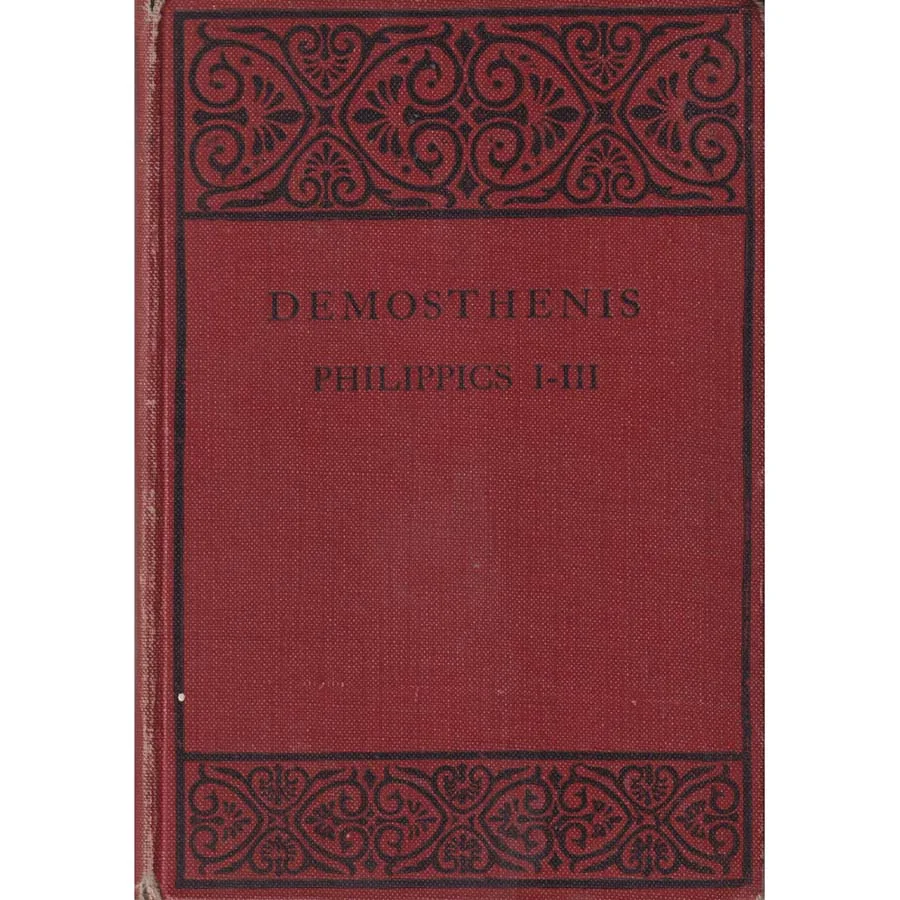
Publisher: Oxford at the Clarendon Press
Format: Hardback
ISBN: none
The Philippics of Demosthenes I–III (1950) by Evelyn Abbott and P. E. Matheson – Oxford at the Clarendon Press – Good Condition – Ex-School Copy
Before politicians had television studios, social media teams and carefully focus-grouped slogans, they had speeches. Very long speeches. Delivered in public. Without PowerPoint. And in the case of Demosthenes, often with the specific objective of persuading Athens that Philip II of Macedon was becoming a rather serious problem.
The Philippics of Demosthenes I–III presents the first three great speeches in which the Athenian orator warned his fellow citizens about the growing power and ambitions of Philip of Macedon — father of Alexander the Great and, from the Athenian point of view, an increasingly unwelcome man to have expanding across the neighbourhood.
Edited by Evelyn Abbott and P. E. Matheson, this 1950 Oxford at the Clarendon Press edition belongs firmly to the grand tradition of classical education in which schoolchildren were expected not merely to know that Ancient Greece existed, but to grapple personally with its politics, rhetoric and language. Educational standards were apparently based on the principle that if Demosthenes could address the Athenian Assembly under threat from Macedon, then a pupil in Croydon could certainly cope with Tuesday afternoon Greek.
The Philippics themselves are masterpieces of political rhetoric. Demosthenes argues that Athens has become complacent while Philip acts decisively, warning repeatedly that hesitation, disunity and wishful thinking will eventually have consequences. In essence, he spends several speeches telling his fellow Athenians that their strategic policy of hoping everything will somehow work itself out is perhaps not quite sufficient.
There is urgency, accusation, patriotism, political manoeuvring and a considerable quantity of rhetorical fire. Demosthenes wants Athens to wake up, organise itself and resist Macedonian expansion before Philip becomes too powerful to stop. History, with its customary lack of tact, subsequently revealed that he may have had a point.
For students of ancient history, politics and rhetoric, the speeches remain fascinating because the arguments can feel surprisingly modern. Governments procrastinate. Citizens complain. Politicians blame one another. Threats are underestimated until they become larger threats. Somebody stands up and announces that everyone should have acted months ago. Two thousand years pass and civilisation continues experimenting with roughly the same system.
This particular copy has additional character because it is an ex-school book from Old Palace School in Croydon. Somewhere in its previous life it presumably sat in a classroom, cupboard, library or schoolbag while generations of pupils encountered Demosthenes with varying degrees of scholarly enthusiasm.
That provenance gives it a little history of its own. This is not merely an old Classics book; it is an artefact from an era of British education when Greek texts from the Clarendon Press were perfectly normal school equipment and nobody seemed particularly concerned that teenagers might prefer something involving spaceships.
The book is in Good condition, although as an ex-school copy it may naturally bear signs of its institutional past and previous use. Rather than diminishing it, these traces arguably make it considerably more interesting. A pristine copy can tell you what Demosthenes said; an old school copy can also quietly remind you that somebody once had to revise it for homework.
There is no ISBN, because in 1950 books were apparently permitted to exist without being assigned a long numerical barcode identity. They simply appeared from Oxford, contained several thousand years of civilisation, and expected you to get on with reading them.
Ideal for collectors of classical texts, students of Ancient Greece, lovers of rhetoric, former Classics pupils wishing to reopen old intellectual wounds, or anyone nostalgic for the educational philosophy that believed a perfectly reasonable way to spend adolescence was translating speeches about Macedonian foreign policy.
Sold by Crappy Old Books — rescuing former schoolbooks from retirement and giving Demosthenes one more opportunity to warn somebody about Philip of Macedon.
Keep browsing: See more Ancient Classics books Other books by Evelyn Abbott and PE Matheson
